How to Safely Mount a TV Over a Stone Fireplace
Thinking about mounting a TV over your stone fireplace? We walk through options, challenges, and how pros safely create a solid backing for your TV.
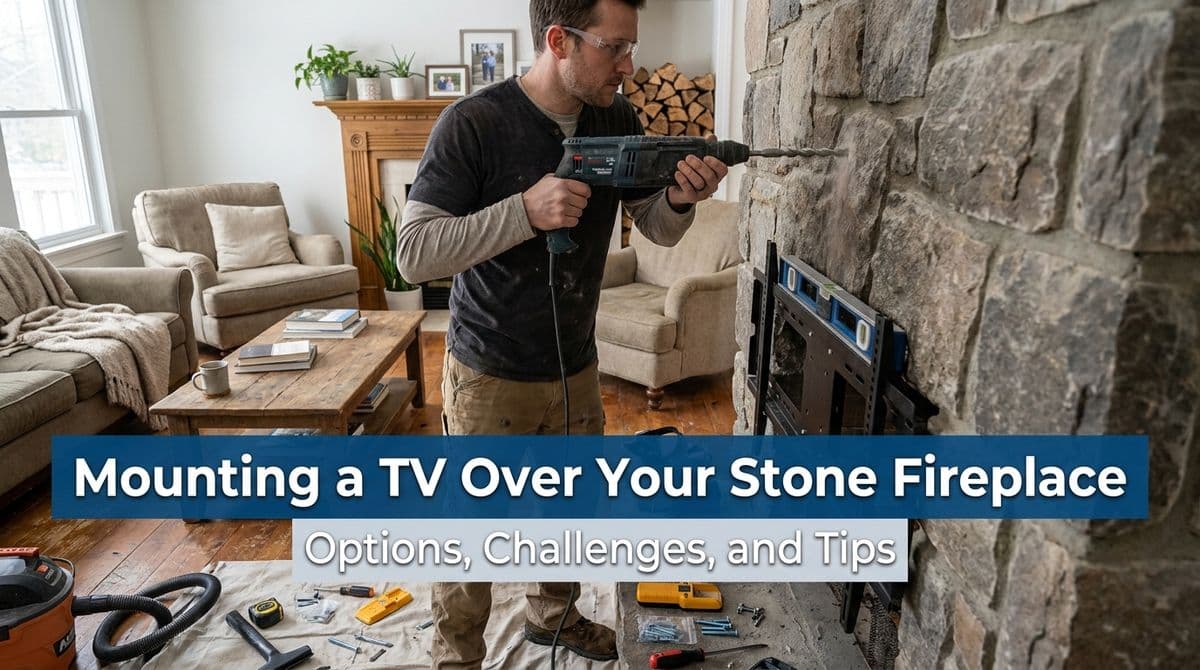
Mounting a TV on a Stone Fireplace: A Real Call That Raised Great Questions
We recently got a call from a homeowner — let’s call him Mark — who had just moved into a new construction home and wanted his 55-inch TV mounted above a stone fireplace. As we were talking, we realized he was asking all the right questions: Is it safe to mount on stone? Do we need to cut into the stone? Is there wood behind it? Do we need an electrician?
Mark’s fireplace had what we see a lot: decorative stone installed over sheetrock, with no wood backer specifically placed for a TV mount. The stone wasn’t flat panels; it was real, uneven stone with different depths and textures. That’s beautiful to look at, but it adds a layer of challenge when you want a secure, level TV.
Using Mark’s project as an example, we want to walk you through your options, the common challenges, and what you should know before anyone starts drilling into your stone.
Why Mounting a TV on Stone Is Different
On a regular sheetrock wall with wood studs, mounting a TV is pretty straightforward. For many of our customers, that kind of job starts around a simple, flat install with no outlet work. But as soon as a stone fireplace enters the picture, the whole process changes.
With Mark’s fireplace, we immediately asked whether the stone surface was flush and flat or irregular and “chunky”. He confirmed it was true stone with varying depths, not a flat stone veneer panel. That one detail tells us a lot about the kind of work required and what’s safe long-term.
Common Challenges Mounting Over a Stone Fireplace
1. No Proper Wood Backer Behind the Stone
In many new construction homes, builders install stone purely for looks. There isn’t always a dedicated wood backer or extra framing placed where a TV might go. That was the case with Mark — beautiful stone, but no hidden structure designed to support a heavy mount and TV.
Without a solid backer, relying only on anchors in stone or mortar can be risky, especially with heavier TVs or full-motion mounts. Over time, heat, vibration, and simple gravity can loosen those fasteners.
2. Irregular, Uneven Stone Surfaces
If your stone is truly three-dimensional — with pieces sticking out at different depths — you can’t just put a flat metal bracket against it and expect it to sit level. That’s why, in Mark’s case, we explained that we would likely need to cut out a section of stone and install two layers of 3/4-inch wood in its place to create a solid, flat mounting surface.
This approach lets us anchor into something we trust structurally, get the mount perfectly level, and avoid stress on weak points of the stone or mortar joints.
3. Heat and Viewing Height Concerns
Every fireplace is different. Some throw a lot of heat straight up the wall; others are much gentler. We always recommend checking the TV manufacturer’s guidelines and, when possible, measuring surface temps above the fireplace during use.
There’s also the comfort factor. Mounting too high can lead to neck strain. Sometimes a tilting or drop-down mount helps make a high-over-fireplace TV more comfortable to watch.
Mount Types That Work Best Over Stone Fireplaces
We walked Mark through different mount options and when each makes sense. Here’s a quick breakdown we often share with homeowners:
Fixed Mount
Best for: Low-profile look, minimal adjustments, when you’re happy with the viewing height.
A fixed mount holds the TV close to the wall. Over stone, this works well if the viewing angle is comfortable and the fireplace doesn’t push too much heat directly up to the TV.
Tilt Mount
Best for: TVs mounted higher than eye level, like above most fireplaces.
Tilting mounts allow the screen to angle downward slightly. For many above-fireplace installs, this is the most practical option, especially when we’ve created a custom wood backer in place of some stone.
Full-Motion (Articulating) Mount
Best for: Wide rooms, off-center seating, or when you want to pull the TV out and angle it.
These mounts put more leverage on the wall, so they demand very strong backing. On stone, we’re extra cautious and typically only recommend these when we can securely tie into framing or engineered blocking behind the finish.
Drop-Down or Mantel Mount
Best for: High fireplaces where you want a more comfortable eye-level viewing position.
These specialty mounts let the TV sit high when not in use and lower down in front of the fireplace when you’re watching. They’re heavier and more complex, so proper backing and precise installation are crucial.
Step-by-Step: How We Approach a Stone Fireplace TV Mount
With Mark, we scheduled a quick site visit after he texted us photos of the fireplace. That’s our standard process for tricky surfaces like stone. Here’s what a typical professional visit looks like, start to finish:
Step 1: Initial Call and Photo Review
We start by asking about TV size, existing outlets, whether the home is new construction, and what the stone looks like. Clear photos (straight-on and from the side) help us see how uneven the surface is and whether there’s any existing wiring.
Step 2: On-Site Inspection
On-site, we verify what’s behind the stone, locate studs if possible, and check how the stone is installed. We also talk through heat concerns, viewing height, and where any components (soundbar, cable box, streaming devices) will live.
Step 3: Plan for Backing and Electrical
If there’s no solid backer, we outline options: cutting out a section of stone and installing layered wood, or in some cases, adding framing from behind (if accessible). For electrical, if there’s no outlet in the right spot, we coordinate with a licensed electrician to add one and, if needed, low-voltage cabling.
Step 4: Mounting and Cable Management
Once backing and power are ready, we install the mount, double-check level, hang the TV, and test everything. We secure and organize cables so they’re as hidden and heat-safe as possible.
Questions to Ask Before You Hire an Installer
Mark did something smart: he asked detailed questions before committing. Here are a few questions we encourage every homeowner to ask any installer:
- “How will you create or verify proper backing behind my stone?”
- “Do you plan to cut or remove any stone, and how will you finish that area?”
- “Are you coordinating with a licensed electrician if an outlet needs to be moved or added?”
- “Which mount type do you recommend for my fireplace height and room layout, and why?”
- “How do you account for heat from the fireplace and protect the TV and cables?”
- “Can you walk me through exactly where the TV will sit and how high it will be?”
When in Doubt, Get a Professional Opinion
Every stone fireplace is a little different. Some can safely hold a simple fixed mount with minimal work; others, like Mark’s, need careful planning, backing, and sometimes collaboration with an electrician.
If you’re staring at a beautiful stone fireplace and a brand-new TV still in the box, it’s worth having a pro come out, take a careful look, and give you options. Done right, you get a clean, secure install that protects your investment — and lets you actually enjoy that fireplace wall instead of worrying about what’s holding your TV up.