Mounting a TV on a Stone or Fireplace Wall: Safety & Cost Guide
Thinking about mounting a TV on a stone or fireplace wall? Here’s what to know about structure, safety, and real-world costs before you start.
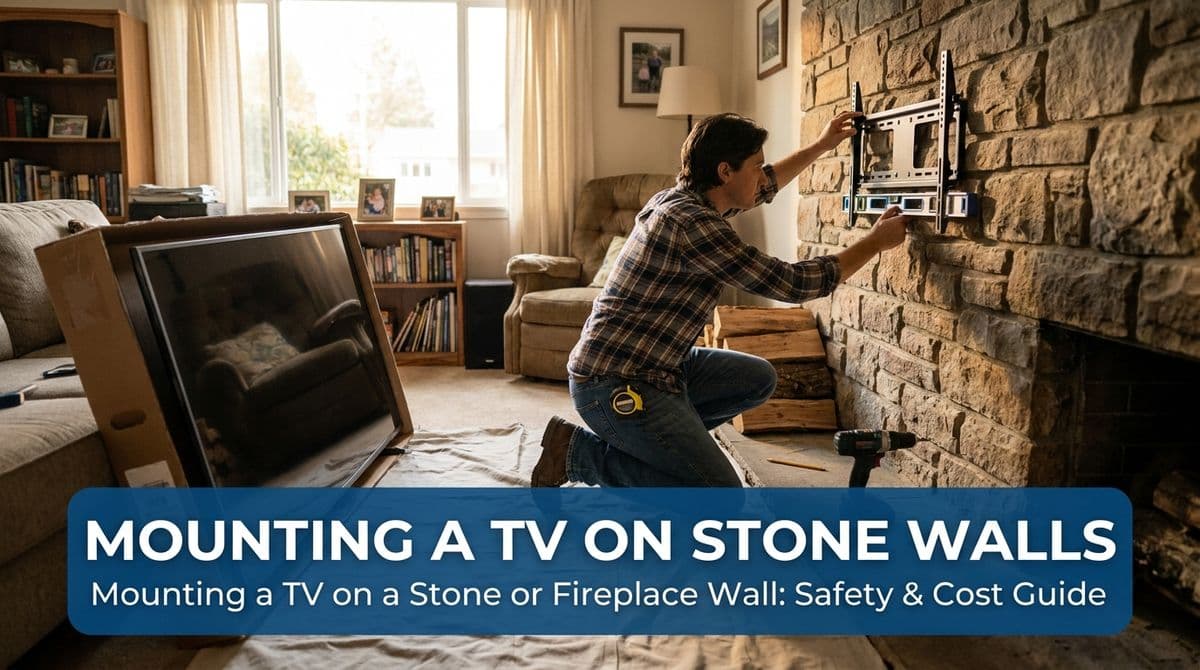
Why Mounting a TV on Stone or a Fireplace Is Different
We recently got a call from a homeowner — let’s call him Mark — who asked a question we hear all the time: “Can you mount a TV on my stone fireplace wall?” His builder had told him there was a wood backer behind the stone, so he was hoping it would be a quick, simple install.
As we explained to Mark, mounting a TV on a stone or fireplace wall can be done safely and cleanly, but it’s rarely as straightforward as a standard drywall install. The uneven surface, the weight of the stone, and the heat from the fireplace all change how we design and price the job.
In this post, we’ll walk you through what we talked about with Mark: how these installs actually work, what we look at on-site, and what most homeowners can expect to pay.
Flat Brackets vs. Uneven Stone: Why the Surface Matters
Mark’s first question was whether the wood backer behind the stone would make the job easier. His builder had assured him, “There’s wood behind there already.” That’s helpful for structure, but it doesn’t solve the biggest challenge: stone isn’t flat.
A TV wall mount is designed to sit flat and tight to a surface. When the stone is uneven, wavy, or has raised edges, there’s no way to get that bracket snug against the wall without dealing with the stone itself. If the bracket isn’t tight:
- The TV can wobble or sag over time
- The mount hardware can be stressed in ways it wasn’t designed for
- You can end up with gaps, crooked alignment, or even safety issues
That’s why, even when there’s a wood backer behind the stone, we usually still need to modify the surface where the bracket will sit.
How We Create a Solid Mounting Surface in Stone
Mark then asked the key follow-up: “So do you actually cut the stone out to do that?” For most uneven stone installations, the answer is yes — but with a careful process.
Here’s the general approach we described to Mark:
- Inspect the wall on-site – We look at the stone layout, mortar lines, and any signs of a built-in backer or framing. Every fireplace wall is different, so we never guess from photos alone.
- Mark the bracket area – We outline where the TV bracket needs to sit so that it will be centered, at the right height, and supported by solid structure.
- Cut and remove selected stone – In that outlined area, we carefully cut out enough stone to create a flat “pocket” for a new backing surface. This is where a lot of the labor time comes in, and it’s why these installs cost more than a standard drywall job.
- Install wood backing flush with the stone – For example, if the stone is about 2 inches thick, we may build out with two 2x4s plus a piece of plywood so the new surface is flush with the face of the surrounding stone.
- Mount the bracket to the new backing – Now the mount has a perfectly flat, solid surface, properly anchored to wood structure instead of random stone edges or mortar joints.
We also explained to Mark that in many cases we aren’t recessing the bracket deep into the wall. Instead, we’re building a flat, structural “island” that lives level with the stone so the TV sits correctly and safely.
Safety and Structural Considerations Above a Fireplace
Beyond the mounting surface, we always talk with homeowners about heat and viewing height when installing a TV above a fireplace.
A few best practices we share on site:
- Heat check – We recommend running the fireplace and feeling the wall where the TV will sit. If it’s hot to the touch, that’s a red flag. Prolonged high temperatures can shorten the life of the TV.
- Clearances – We look at the distance between the top of the firebox and the bottom of the TV, and whether there’s a mantle deflecting heat away from the screen.
- Cable management – Stone and brick make it harder to hide wiring. Sometimes we can route through the chase or side walls; other times we plan surface raceways that look as clean as possible.
- Viewing comfort – Mounting a TV too high can cause neck strain. We try to balance aesthetics (centered over the fireplace) with practical viewing height, and in some cases recommend a tilt or full-motion mount.
What It Costs to Mount a TV on Stone or a Fireplace
Once Mark understood the extra steps involved, his next question was the one everyone eventually asks: “What does something like this usually cost?” While we always need to see the actual wall before giving a firm quote, we walked him through our typical pricing ranges so he’d have a realistic expectation.
Here’s how we generally break it down:
- Standard TV install on drywall or existing flat wood backer: labor typically starts around $140 for a straightforward mount (not including materials or mount, if needed).
- Stone or uneven fireplace wall with cutting and backing: because of the extra labor (cutting stone, dust control, cleanup, building out the backing), we explained that those jobs often end up around $170+ in labor plus materials and the TV install itself.
- Recent real-world examples: the last couple of uneven stone fireplace installs we completed landed in the $350–$400 range for a single TV, depending on complexity and materials.
Those numbers aren’t a formal quote, but they help homeowners like Mark understand why a fireplace install costs more than hanging a TV on a flat bedroom wall.
When We Need an On-Site Visit (And How to Prepare)
Because every stone fireplace and wall build is different, we usually schedule a visit before we commit to final pricing. For Mark, we asked him to send over:
- Clear photos of the fireplace and the surrounding wall
- The approximate size of the TV he wanted to mount
- Whether he already had a wall mount, and what type (fixed, tilt, full-motion)
- Any info from the builder about a wood backer or framing behind the stone
From there, we can come out, inspect the wall, and then send a written estimate so there are no surprises. That’s exactly what we offered Mark: a site visit, followed by a detailed quote sent via email so he could review everything before moving forward.
Thinking About Mounting a TV on Your Stone or Fireplace Wall?
If you’re in the same situation as Mark — a beautiful stone fireplace and a TV you’d love to hang above it — the key things to keep in mind are structure, safety, and the realities of cost. Stone and fireplaces add character to a room, but they also add complexity.
With the right planning, a solid backing system, and a careful install, you can enjoy a clean, safe setup that looks like it was always meant to be there. And if you’re ever unsure whether your wall is a good candidate, we’re always happy to take a look and talk you through the options.